There was nothing unusual about the request for information on Quanser's control hardware that we received few months ago, except for the note: "FYI. We use a pair of your LCAMs to drive the beam director of our 8 kw laser power beaming system for NASA Space Elevator Games. We finished second last year." Well, that sparked some interest, because how higher can Quanser system ever get?!
Surprisingly, the competing team is not affiliated to any university or college. A group of hobbiests took on the challenge. "The competition has caught my attention," explained Brian Turner, the captain of the Kansas City Space Pirates team, " because it's something new that hasn't been done before. It's truly a multi-discipline challenge."
Brian gathered a team of other enthusiasts with knowledge and skills in different areas - electrical engineering, mechanical engineering, specialists on solar energy and optics. But the team is not limited to professionals: Dan Leafblad joined as a student at the age of 14.
As the NASA Space Elevator Games rules evolved, requiring the climber to go higher and higher, KC Space Pirates had to turn to more sophisticated system design. Mirrors focusing the sun beam were not sufficient to power the climber up to 1km. Instead, the team turned to laser. More complex system meant more design challenges. "In order to keep the laser aimed as the climber goes up, you need to track it," explained Brian. "We augmented the laser system so that it was able to tell whether the climber was moving upwards, downwards, left or right and used a fast steering mirror to steer the beam. The steering mirror was driven by voice coils." Powering the voice coils turned out to be an issue. After trying several other options, the team came across Quanser's LCAM - linear current amplifier. LCAMs proved to provide ideal operation range in terms of current, voltage and resistance. "We just did the calibration and your solution worked for us beautifully - there was no longer a problem," Brain commented.
Although the team did not win the prize in the 2010, they came pretty close. But what KC Space Pirates can claim are kids inspired to pursue science and engineering not only as a hobby, but also as a career. KC Space Pirates team members often visit middle and high schools to talk about science and engineering. "Competitions like this," says Brian, " turn science into sport. The kids see that participation in science can be fun and cool, just as the participation in sports."
Take Dan Leafblad, one of the KC Space Pirates. He himself joined the team at 14, after hearing Brian talking at the local science club. "Before getting involved with the team, I had no deep interest in science or robotics," says Dan. "After few months with the Space Pirates, it was clear to me I want to do engineering in the future. " As Dan explained, it was great for him to see that he can use the math he learned at home in a real application and design a part of the system. Last fall Dan started his first year at the Missouri University of Science and Technology, Rolla. And no wonder right in his freshmen year, Dan became a member of the Missouri S&T Solar Car Team.
And as for the LCAM, we have to see whether it will "reach" the space. It's great to know it has the power to do so.

Tuesday, January 18, 2011


Monday, January 17, 2011
Quanser Curriculum Helps Assess Students' Knowledge and Skills
Educational institutions and programs around the globe undergo accreditation process to demonstrate they can meet standards set for higher education by their governments or professional organizations.
ABET Accreditation
In the United States, accreditation is a peer-review process, independent of government and coordinated by accreditation commissions and member institutions. One of the most respected organizations specializing in accreditation of educational programs in applied science, computing, science and technology is the Accreditation Board for Engineering and Technology - ABET.
Focused on Learnig Outcomes
In the past, ABET’s criteria for accreditation outlined the major elements that engineering programs must have, such as program curricula, faculty type and facilities. However, in the last decade the focus shifted away from the inputs - what material is taught, to the outputs - what students learned. This approach encourages innovation in engineering programs and program improvements rather than forcing all programs to follow the same standard.
If your course is part of the ABET or a similar engineering program assessment, you most likely need to evaluate students' ability to:
- apply knowledge of math, science and engineering
- design and conduct experiments, and analyze and interpret data
- communicate effectively
- use techniques, skills and modern engineering tools necessary for engineering practice
Student Outcome Assessment Embedded in the Course Curriculum
To help educators with assessment of their course, Quanser teamed with Dr. Hakan Gurocak from the Washington State University in Vancouver, USA to rewrite the instructor manual for the Rotary Position and Rate Control Servo (SRV02), one of Quanser's most popular teaching systems used in engineering labs worldwide. The goal was to embed student outcome assessment in the curriculum and provide professors with a simple framework and set of templates that allow them to measure and document students' achievments of various performance criteria.
Assessing Students' Knowledge
For example, every chapter of the laboratory workbook includes Pre-Lab Questions section, that examines understanding of theoretical background and preliminary calculations relevant to the in-lab experiments. These pre-lab questions require students to apply math, engineering and science knowledge through calculations and problem solving strategies (i.e. Student Outcomes criteria A as defined by ABET). If pre-lab questions are assigned as homework, the results can be easily assessed using scoring sheets and scoring criteria that are provided in the workbook.
Assessing Students' Skills
The Lab Experiments section of the laboratory workbook provides step-by-step instructions to conduct lab experiments and record collected data. The experiments require students to design and conduct experiments, analyze and interpret data and use various techniques, skills and modern engineering tools, corresponding to the applied part of engineering and mapping Students Outcomes criteria B and K as defined by ABET. As a part of lab work, students are asked to prepare a report and describe used procedures and achieved results, analyse these results and draw conclusions. Lab reports demonstrate level of achieved effective communication skills, i.e. correspond to the Student Outcomes criteria G as defined by ABET. Again, laboratory workbook provides scoring sheets and scoring criteria so that the outcomes can be easily assessed and documented.
Outcome of the Course
Once all pre-lab and lab work is assessed, it is easy to get the overall outcome of the course. Assessment Workbook, developed by Quanser using Microsoft Excel takes all scores and assembles them into a single score for each Student Outcomes criteria assessed during the course. This Assessment Workbook has no automatic features and allows user to customize it in any way.
For a sample of ABET-aligned rotary servo curriculum, please contact Quanser at info@quanser.com
ABET Accreditation
In the United States, accreditation is a peer-review process, independent of government and coordinated by accreditation commissions and member institutions. One of the most respected organizations specializing in accreditation of educational programs in applied science, computing, science and technology is the Accreditation Board for Engineering and Technology - ABET.
Focused on Learnig Outcomes
In the past, ABET’s criteria for accreditation outlined the major elements that engineering programs must have, such as program curricula, faculty type and facilities. However, in the last decade the focus shifted away from the inputs - what material is taught, to the outputs - what students learned. This approach encourages innovation in engineering programs and program improvements rather than forcing all programs to follow the same standard.
If your course is part of the ABET or a similar engineering program assessment, you most likely need to evaluate students' ability to:
- apply knowledge of math, science and engineering
- design and conduct experiments, and analyze and interpret data
- communicate effectively
- use techniques, skills and modern engineering tools necessary for engineering practice
Student Outcome Assessment Embedded in the Course Curriculum
To help educators with assessment of their course, Quanser teamed with Dr. Hakan Gurocak from the Washington State University in Vancouver, USA to rewrite the instructor manual for the Rotary Position and Rate Control Servo (SRV02), one of Quanser's most popular teaching systems used in engineering labs worldwide. The goal was to embed student outcome assessment in the curriculum and provide professors with a simple framework and set of templates that allow them to measure and document students' achievments of various performance criteria.
Assessing Students' Knowledge
For example, every chapter of the laboratory workbook includes Pre-Lab Questions section, that examines understanding of theoretical background and preliminary calculations relevant to the in-lab experiments. These pre-lab questions require students to apply math, engineering and science knowledge through calculations and problem solving strategies (i.e. Student Outcomes criteria A as defined by ABET). If pre-lab questions are assigned as homework, the results can be easily assessed using scoring sheets and scoring criteria that are provided in the workbook.
Assessing Students' Skills
The Lab Experiments section of the laboratory workbook provides step-by-step instructions to conduct lab experiments and record collected data. The experiments require students to design and conduct experiments, analyze and interpret data and use various techniques, skills and modern engineering tools, corresponding to the applied part of engineering and mapping Students Outcomes criteria B and K as defined by ABET. As a part of lab work, students are asked to prepare a report and describe used procedures and achieved results, analyse these results and draw conclusions. Lab reports demonstrate level of achieved effective communication skills, i.e. correspond to the Student Outcomes criteria G as defined by ABET. Again, laboratory workbook provides scoring sheets and scoring criteria so that the outcomes can be easily assessed and documented.
Outcome of the Course
Once all pre-lab and lab work is assessed, it is easy to get the overall outcome of the course. Assessment Workbook, developed by Quanser using Microsoft Excel takes all scores and assembles them into a single score for each Student Outcomes criteria assessed during the course. This Assessment Workbook has no automatic features and allows user to customize it in any way.
For a sample of ABET-aligned rotary servo curriculum, please contact Quanser at info@quanser.com
Tuesday, January 11, 2011
Virtual Experiments Introduced at 49th IEEE Conference on Decision and Control
Last month I had the opportunity to attend the 49th IEEE Conference on Decision and Control in Atlanta, Georgia USA. Once again, the Conference on Decision and Control brought together an international community of researchers and practitioners in the field of automatic control to discuss the latest advancements of the discipline, shape its future directions, and promote its diffusion among the scientific community at large.
The highlight of our exhibit at the conference was our announcement of our partnership with John Wiley and Sons to feature 10 virtual experiments from Quanser in the newly released 6th edition of Norman S. Nise’s Control Systems Engineering. As many of you know, Nise’s book is the most wildly adopted text for core control courses in mechanical, electrical and other engineering programs.
The ten virtual control experiments are powered by LabVIEW and allow students to manipulate Quanser's simulated lab plants and view realistic response behavior. The virtual experiments will help deepen students' homework learning experience and help them prepare for their actual lab work using Quanser’s real plants.
For more information about the virtual experiments supplied with the textbook please visit our blog: http://quanser.blogspot.com/2010/12/teach-control-virtually-anywhere-with.html. And, for a limited time, you can request a complimentary copy of Nise’s text by completing an online survey at http://survey.constantcontact.com/survey/a07e35fyitnggtjdjjy/start.
Tuesday, December 14, 2010
Engineering Lab Attracts and Motivates Students
One of the items that I love about my work at Quanser is the opportunity to visit very exciting research and teaching labs at universities and colleges throughout the US and Canada. Each one has something interesting to show – an interesting engineering teaching lab, an advanced research project, or both. One recent trip took me to Colorado and I can’t help but share my amazement with the University of Colorado at Boulder’s Integrated Teaching & Learning Lab (ITL Lab). It’s a perfect example of hands-on, engaging learning - the kind Quanser has been preaching schools to adopt.
Derek Reamon, co-director of the ITL Lab, discussed with me the 34,000 square-foot facility dedicated to engineering. It felt like visiting a science center. Equipped with cutting-edge technology – Quanser’s SRV02-based rotary experiments among them - the lab serves students from the first year to sophomore level, and courses from design and build, invention and innovation to senior design projects. Using a highly effective system, each engineering department can order experiments for their courses from an online catalogue and book a time to work with the selected experiments. The ordered system can be easily wheeled to workstations – at the ITL Lab or anywhere on campus – and ITL Lab’s staff is available to set it up.
The ITL Lab is one of the most attractive features of the engineering school at the UC Boulder. Plus, the university saves space and financial resources, as the same equipment is not duplicated in the labs of each engineering department. The novel approach to learning gained the ITL Lab awards and recognition from the National Academy of Engineering as well as from industry leaders such as Boeing and Hewlett Packard.
My notion of the ITL Lab similarity to a science center is not just co-incidental: every year, thousands of K-12 students and teachers visit to participate in hands-on, ears-on and minds-on K-12 engineering camps, events and workshops. The staff of the ITL Lab also visits schools in the area to talk and demonstrate science and engineering and spark the interest of the future generation in these subjects.
Many other universities adopted the concept of the integrated multi-disciplinary labs serving several engineering departments. If you are looking for the inspiration, let us know – we can put you in touch with one close to you.
- Leor GreblerSunday, December 12, 2010
Teach Control Virtually Anywhere with New Text from Norman Nise
 Control Systems Engineering by Norman S. Nise is the most wildly adopted textbook for core control courses in mechanical, electrical and other engineering programs. The sixth edition, which is releasing in 2011, offers a dynamic new feature: 10 virtual experiments from Quanser. The experiments are powered by LabVIEW and allow students to manipulate Quanser's simulated lab plants and view realistic response behavior. The virtual experiments will help deepen students' homework learning experience and help them prepare for the actual lab work.
For a limited time, you can request a complimentary copy of the text. But first, here's more information about the virtual experiments supplied with the textbook:
Automobile Suspension allows to explore the dynamics of a two degree of freedom system — an automobile suspension system driving over a bumpy road — demonstrated with the Quanser Active Suspension system modeled in LabVIEW.
With Open-Loop Servo Motor students can explore the dynamics of the Quanser Rotary Servo system modeled in LabVIEW. It is particularly important to know how a servo motor behaves when using them in high-precision applications such as hard disk drives.
Rotary Inverted Pendulum simulates the linear and non-linear model of the Quanser Rotary Inverted Pendulum in LabVIEW. The behavior of an inverted pendulum is similar to a variety of systems, such as Segway transporters and human posture.
First-Order Open-Loop Systems teach students how to find a first-order transfer function representing the Quanser Rotary Servo, then validate the model by simulating it in LabVIEW. Servo motors are used in mechatronic gadgets such as cameras.
Second-Order System Response experiment allows to observe the effect that natural frequency and damping ratio have on controlling the speed response of the Quanser Linear Servo in LabVIEW. The concept is applicable to automobile cruise control or speed control of a train or subway.
Position Control Gain Design teaches how to design the position control gain for the Quanser Linear Servo and simulate its closed-loop response in LabVIEW. This concept is used, for instance, to control a rover exploring the terrain of a planet.
With the Stability experiment students learn how to evaluate the stability of the Quanser Linear Inverted Pendulum in LabVIEW. When in the upward balanced position, this system addresses the challenge of stabilizing a rocket during take-off. In the downward position it emulates the construction gantry crane.
Steady-State Error experiment teaches how to find the steady-state error of the Quanser Rotary Servo when subject to an input or a disturbance by simulating it in LabVIEW. This analysis becomes important when developing controllers for bottle labeling machines or robot joint control.
PD Controller Design experiment uses root-locus to design a PD controller for the Quanser Ball and Beam using LabVIEW. The Ball and Beam is an unstable system, similar to exothermic chemical processes that have to be stabilized to avoid overheating.
Improving Transient Response and Steady-State Error Using Rate Feedback and PI Control teaches students how to design a compensator in LabVIEW that controls the ball position in the Quanser Magnetic Levitation system. Magnetic Levitation technology is used for modern transportation systems that suspend, such as the high speed Magnetic Levitation train.
The new edition of the text is published by John Wiley and Sons and will be available for purchase through them in 2011. If you would like to review a complimentary copy of the text, please contact us at info@quanser.com. For more information about Quanser's real control plants and modules, please visit our website.
Wednesday, December 8, 2010
Stateflow with QUARC
At Quanser I am always looking to find new ways to make it easier to use our variety of products. As I developed controllers for the Quanser Qball-X4 Unmanned Aerial Vehicle (UAV) I found myself building large, complex models in order to create sophisticated, autonomous controllers. Designing a fully-autonomous controller for a complex system such as a UAV requires many considerations and safety checks to ensure the system operates safely and as it should. For example, at the start of a mission there are various initialization procedures and safety checks that occur. Then, the vehicle enters into a controlled takeoff. Next, the vehicle executes the various tasks that make up its mission. And finally, the vehicle performs a landing and power down.
These complex sequences of operating modes and transitions between modes requires careful planning and design. The most suitable design structure for this would be a state machine. Well, as I found out first hand, Simulink (although great for realt-time control) is not the best tool for designing state machines. Thankfully, The MathWorks has a blockset called Stateflow, which allows you to insert state machine charts directly into a Simulink model. The Stateflow chart gives you a graphical design environment different from Simulink and designed for state machine development.
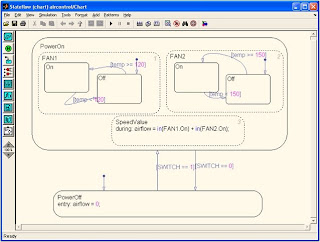
Using Stateflow, I can develop state machines easily and quickly. Stateflow also supports code generation (with Stateflow Coder), so that I can generate code and download it to my target of choice (e.g., Gumstix with QUARC). I can also see graphically at run time the execution of the state machine and which states are currently active. Stateflow expands on the traditional Mealy/Moore state machines and provides useful tools such as temporal operators, Embedded MATLAB Functions, Simulink Functions, variables, events, and support for C-code.
In my application, the Qball UAV mission controller, I chose to divide my model into two parts: Stateflow chart and Simulink controller (although the Stateflow chart resides within the Simulink model as a block). In my Stateflow chart I put all of my state machine logic, operating mode/state, temporal operations, safety checks, etc. In my Simulink controller I build my continuous time controllers, plants, communications, and hardware-in-the-loop interfacing. This is just my preferred design methodology. This allows me to decouple my state machine and safety checks from the Simulink model, which makes extending and maintaining the model a whole lot easier. Now, my controller is not burdened with safety checks and operating mode checks dispersed throughout the model since it is all concentrated in my Stateflow chart.
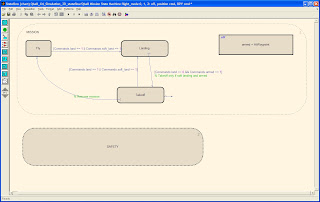
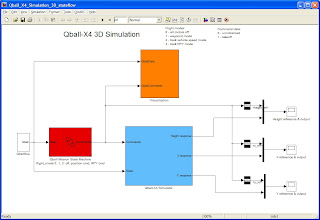
In my final design, I have my main state machine that allows me to arm and disarm the Qball, schedule autonomous tasks such as waypoint tracking, automatically handle transitions between TAKEOFF, FLY, and LAND operating modes, and also concurrently monitor various safety checks. If at any time a safety check fails or timeout occurs, a LAND event is generated that forces a transition from a FLY state to a LAND state so that the Qball is forced to land.
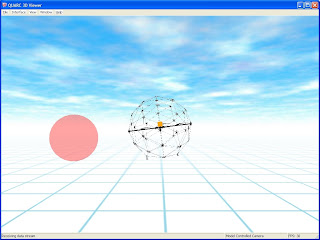

At Quanser we see possibilities for using Stateflow in so many of our applications: haptics and telerobotics, unmanned aerial and ground vehicles, simulations and 3D visualization, rehabilitation robots, communications, large-scale integrated systems, vision-based tracking and localization, and many more. I would encourage anyone to take a look at Stateflow and try to find innovative ways to use it in Quanser experiments. Good luck!
Cameron
Monday, December 6, 2010
Body Forward!
This last Saturday somebody enchanted my kids: no need to wake them up or remind them ten times to get ready - they managed everything in a record time. So by 8.15 AM we were wondering around the lobby of the Woburn Collegiate Institute in Scarborough, looking for the rest of the Huron Hawks Team - and their Lego Robot. The day of their FIRST Lego League Qualifying Tournament was finally here.
 Huron Hawks getting their Lego robot ready for the tournament.
The robot matches were hilarious! While the teams were cheering on the side, two brave robot operators had to cope with the pressure and try to fulfill in 2 1/2 min as many of the fifteen tasks as possible. It was amazing to see what these kids could do!
 In the matches, Lego robots have to perform series of tasks in a limited time.
As a parent, I must express many thanks to teachers, coaches and all volunteers who dedicate their time to bringing this event together. And to Quanser engineers who participate in workshops, career days and competitions and inspire grade- and high-school kids to become engineers too.
 Huron Hawks getting their Lego robot ready for the tournament.
 Woburn Collegiate was like a little hive - full of mostly 4 - 6 graders eager to put their robots into the ring and compete in the FLL's Body Forward Challenge. For many of the kids it was a first venture into the realms of biomedical engineering. Their robots had to fix broken bones, get to a syringe or patch the heart. Plus, they did their own research on an illness they found interesting and prepared a poster presentation. I bet you never heard about the Zollinger Ellison syndrome. Huron Hawks can tell you what's the cause and how it can be treated.


Part of the FLL competition is a project presentation - this year tied to biomedical engineering.
The robot matches were hilarious! While the teams were cheering on the side, two brave robot operators had to cope with the pressure and try to fulfill in 2 1/2 min as many of the fifteen tasks as possible. It was amazing to see what these kids could do!
 In the matches, Lego robots have to perform series of tasks in a limited time.
For Mr. Goodyear, coach of Huron Hawks and teacher at the Huron Street Public School, it's all about team work: kids learn how to present their ideas and listen to the ideas of others, how to find roles in the team they can contribute their best and how to work towards a deadline. It's a great way how to capture their interest in science and engineering! Let's see what they will invent in the future!

Two robot operators control the robot during the match, switch the robot arms to make it push, pull or lift various objects.
Subscribe to:
Posts (Atom)